Quantum will change the world & that's why we need to have the conversation now
In the interview series State of Quantum, we speak with quantum thinkers and doers who are not only concerned with what quantum can do, but with what it means for our society and the economy — and why it is important for the Netherlands to continue investing in quantum.
We recently spoke with Julia Cramer, quantum researcher in Quantum and Society at Leiden University. While she does not build quantum computers herself, she studies the ways in which quantum technology and society interact, and which choices we already need to make today.
“The challenge with quantum is not that it is too complicated,” says Julia Cramer, “but that people don’t yet feel that it concerns them. And when a technology feels incomprehensible and beyond your influence, people disengage. As quantum developers, we have a responsibility to prevent that.”
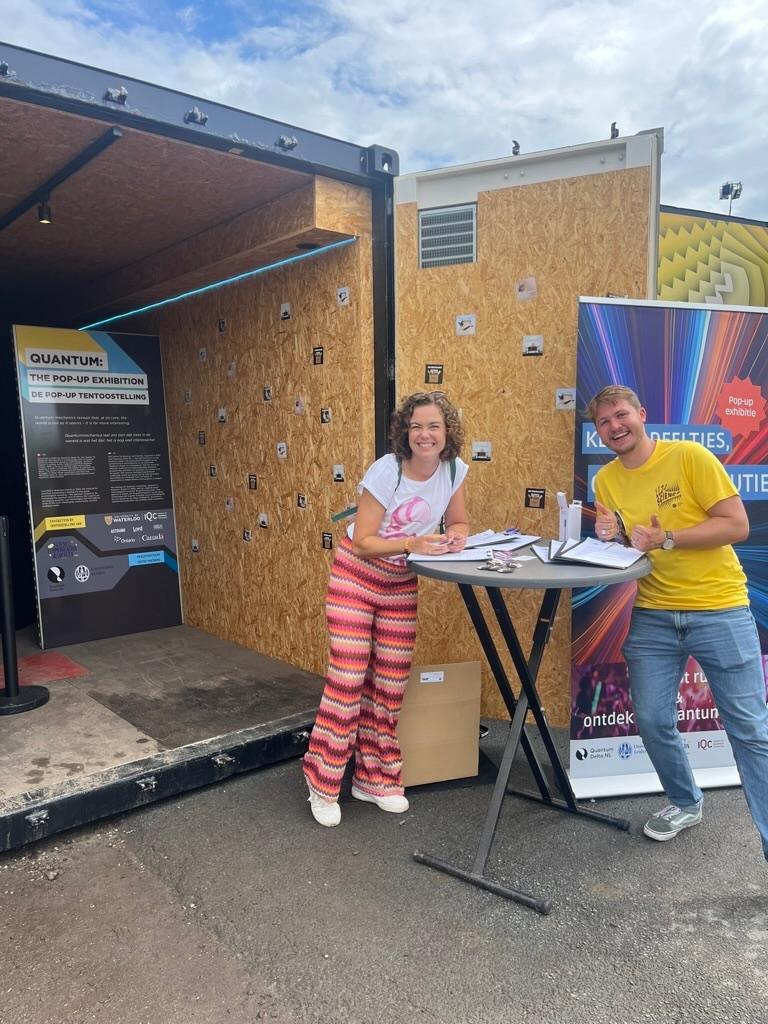
In a way, that disengagement is understandable. After all, quantum information technology is not yet in our phones, homes, or hospitals, but instead it is found in lasers and transistors. There has been no sudden breakthrough that has turned everyday life upside down. In fact, most people in the Netherlands have little awareness about what quantum is. And if they do know something about it, it's not top of mind. Cramer vividly remembers standing at the Lowlands music festival a few years ago with a travelling quantum exhibition. Visitors could see quantum installations and receive explanations. Before and after their visit, they filled out a short questionnaire. “Afterwards, people thought they knew more about quantum,” she says. “But their interest actually declined slightly.”
It sounds paradoxical, but Cramer sees this more often. “The feeling of ‘I understand this now’ can also be an endpoint, like: great, checked off.” Whereas, in her view, quantum requires long-term engagement. This is not a technology you see once and then forget. As a society, we will be dealing with it for decades to come, with applications in every area of society — from healthcare to security and digitalisation. That's why, she says: “Wonder is nice, but it’s not enough. You don’t want a one-off "wow" experience. You want people to build a lasting relationship.”
From dark labs to public questions
With her research group, Cramer is keen to play an active role in furthering people's relationship to the technology. Not only because it is important for public debate, but also because she herself is deeply fascinated by the strange world called quantum. In fact, she has studied physics at TU Delft, conducted experiments with light particles, went to Switzerland for her master’s degree, and later earned her PhD on error correction for quantum computers. “Quantum states are extremely fragile,” she explains. “The smallest disturbance can derail a computation. Without error correction, a quantum computer remains unreliable.”
Still, during her PhD she noticed her interests broadening. She wrote blogs, gave lectures, and performed in theatre shows. “I realised I found it just as interesting to talk about the technology as it was to work on it myself.” Gradually, she became a point of contact on the topic for industry and the media. “It's not because I had an answer to everything, but because I wanted to take the questions seriously.”
A technology without a public
And there is no shortage of questions. For example: what can we realistically expect from a quantum computer? Who will control the technology and the data it can unlock? How do we ensure that knowledge is shared broadly, rather than remaining confined to a select group of specialists? “If, as a society, you have no idea what you are getting involved in, then you can’t make informed choices,” says Cramer. “Then the technology overtakes you.”
It reminds her of earlier innovations: the internet, artificial intelligence, biotechnology. Each time, there was an initial phase in which the technology was mainly for researchers and pioneers, far removed from everyday life. Only later, often after major applications or incidents, did its impact become clear. “With AI, for example, the societal conversation lagged behind,” Cramer says. “The technology was rolled out everywhere first, and only then did we start asking what it means for work, privacy, and power.”
Quantum may progress more slowly, she expects, because it is hardware-intensive. “But that does not make this moment any less urgent.” On the contrary. “Precisely because quantum technology is so fundamental, it will eventually touch on public values such as security, accessibility, dependence, and sovereignty.”
According to her, the societal impact lies not only in what the technology can do, but especially in who can use — or misuse — it. “Countries or organisations without access may become dependent on those that do have it,” she says. “And dependence is rarely neutral.”
Technology can also drive wedges between people. “You may see a divide between those who feel competent dealing with it and those who disengage,” says Cramer. That applies not only to citizens, but also to institutions. Hospitals, municipalities, or small businesses that lack expertise risk being sidelined. “If quantum remains a technology discussed only by experts, there is a danger that decisions will be made without public debate about desirability, limits, and values.”
Hardware store
So quantum needs to move from the lab to the street. But how? Many people disengage as soon as the word is mentioned. “They think it’s something you buy at a hardware store,” Cramer jokes. One thing she knows for sure: don’t make it too school-like. “We often think people first need to understand what a qubit is,” she says. But her research suggests otherwise. In workshops, she gave participants hardly any technical information and instead asked them to sketch future scenarios. “That worked surprisingly well,” she says. “People asked questions about power, security, and accessibility, not about formulas.”
It made her reflect. “As a physicist, you quickly assume that understanding starts with knowledge. But people use technologies every day that they don’t understand.”
The core question, in her view, is therefore not how much people know, but whether they feel taken seriously. “Whether their concerns and values have a place.” That is why she explores alternative forms of engagement, such as games and scenario exercises. Not to turn people into experts, “but to give them the feeling that their questions matter.”
The Netherlands as a testbed
The research Cramer conducts is unique worldwide. This is partly because Quantum Delta NL deliberately invested from the very beginning in both technological development and also in the societal, legal, and ethical aspects of quantum.
“That is truly exceptional,” she says. “Many countries acknowledge that this is important, but do not allocate structural funding for it.” In the Netherlands, this has happened, resulting in new research groups and academic chairs specifically focused on the societal dimensions of quantum technology.
Internationally, there is strong interest in this approach. “I get questions from other countries asking: how did you organise this?” At the same time, the position is vulnerable. Interdisciplinary research does not always fit within existing funding structures. “It is often too technical for the social sciences and too societal for technical calls. As a result, it risks falling between the cracks.”
She therefore hopes that attention to quantum will continue after the National Growth Fund subsidy ends in 2027, and that there will be a new impulse from the government. Precisely because the conversation needs to be ongoing. As Cramer puts it: “Not to stir up fear, but to ensure that people can already start relating to this technology today.”